

Looking to visit Porto? In this post, I share my expert insights and critical tips — focusing on the city itself, from landmarks and neighborhoods to everyday life — so you can enjoy it fully while avoiding common tourist traps.
In July 2025, as part of our trip to Portugal, we visited Porto — the country’s second-largest city, known for its colorful façades, tiled churches, and steep cobbled streets. The city captivates with vibrant culture and rich history, but it also comes with contrasts: tourist crowds, uneven infrastructure, and attractions that don’t always live up to the hype. With a professional eye trained in hospitality, I’ll share what truly matters when planning your visit to Porto: the highlights worth your time, the overrated spots you can skip, and the small everyday experiences that make the city unforgettable.
This article focuses on Porto itself — its landmarks, neighborhoods, and daily rhythm. If you’re looking for insights on the port wine houses of Gaia or the vineyards of the Douro Valley, you’ll find those covered in a dedicated companion article.
🏛️ What Truly Deserves a Spot on Your Porto City Itinerary
🦁 From Carmo to Lello: Hidden Corners, Photo Spots, and One Persistent Myth
Igreja do Carmo & Igreja dos Carmelitas
These two churches sit side by side, separated by what might be Porto’s quirkiest building: the tiny hidden house wedged between them. It’s just three stories, each a single narrow room, with a staircase that feels designed for hobbits. Architecturally, it’s not much, but the story is fascinating — in the basement of Carmo, a short documentary explains why the house exists at all. For lovers of oddities the video is worth a look, not the house itself.
The “PORTO” Letters
Right next to the fountain, the oversized PORTO sign is exactly what it looks like: a place for selfies. If you want the shot, it’s there. If not, you won’t miss anything. Just be aware it can be tricky to get a clean photo, since many visitors are usually lined up or circling around trying to frame their own perfect shot.
Livraria Lello
Across the street, you’ll find Livraria Lello, often called one of the most beautiful bookstores in the world. Its carved wood, stained glass, and sweeping staircase are stunning — but don’t come here expecting Harry Potter magic. Despite the legend, J.K. Rowling has confirmed she never wrote here, nor even stepped inside during her years in Porto.
So why does the myth persist? Probably because travelers want stories with a touch of magic, and Lello feels like it should belong to Hogwarts. That’s enough for many visitors.
Be prepared, though: in summer, you can wait up to 45 minutes outside in line before entering, ticket in hand. Inside, it’s impressive if you truly love bookstores, but manage expectations — this is about architecture and atmosphere, not a Harry Potter attraction.
University of Porto (Reitoria)
Overlooking the square, the University anchors the area. It’s not a tourist site in itself, but its presence explains the energy here: cafés full of students, bookshops, and a young buzz that mixes naturally with Porto’s older bones.
Praça de Lisboa (Shaded Park)
Beside the University’s building, this elevated garden is a welcome pause from Porto’s steep streets. Students sit in the shade, locals rest on benches, and it’s a pleasant reminder that sometimes the best travel moments are the simplest.
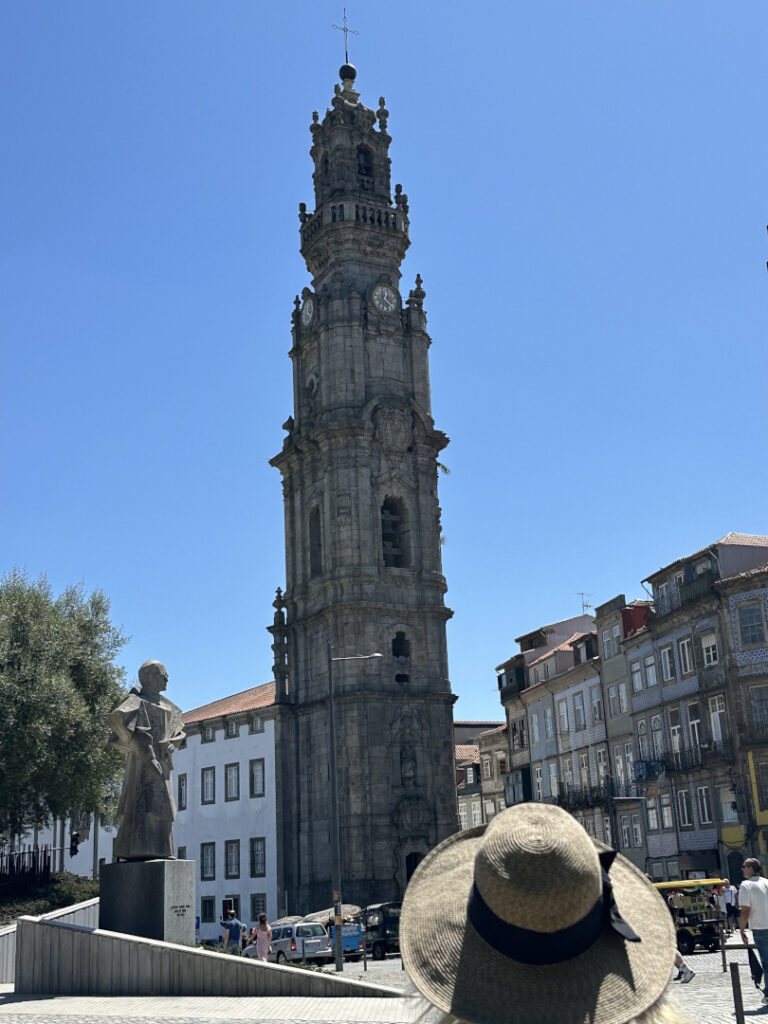
Clérigos Tower, its Church & Museum
Just across Praça de Lisboa stands the Clérigos complex, one of Porto’s defining landmarks. The tower climb is the centerpiece and, despite its drawbacks, almost impossible to skip if you want to understand the city. Be prepared for 225 narrow steps in a very tight spiral staircase, where you’ll regularly have to press into corners to let descending visitors pass. At the top, the view is indeed sweeping and memorable — but the platform is small, and with too many people it quickly becomes uncomfortable. The church itself is compact but richly decorated in baroque style, worth a look though not remarkable compared to other European churches. There’s also a light show held inside the church at night; we didn’t attend, but it may appeal if you want an evening activity. Finally, the museum explores the Brotherhood of Clerics and displays a collection of Christ relics. It’s professional but standard, unlikely to surprise visitors who have seen similar collections elsewhere. In short, the tower is a must-see for the view and its symbolic status, but the experience comes with cramped spaces and crowds, while the church and museum are simply decent complements.

🛍️ Around Bolhão: Where Convenience Meets Authentic Porto Life
Our Airbnb — our base at the heart of the city
For this trip, we stayed in an Airbnb on Rua de Santa Catarina 221 — a location that turned out to be the perfect balance of lively and calm. On the top floor with a balcony facing the back of the building, our apartment avoided the street noise while still letting us feel the effervescence of Porto just outside. At night, it was peaceful; by day, we could step out the door and be instantly in the middle of the action. The air conditioning was only in the bedroom, but that’s where it matters most in July. A standing fan in the living room kept things comfortable enough. Not luxurious, but practical and very well located.
Rua de Santa Catarina
Right outside our door, Santa Catarina is Porto’s main shopping artery. Despite the crowds during the day, the street has a friendly rhythm. In the evenings, it transforms into a pleasant promenade where locals and visitors alike gather around small terraces and gelato shops. It feels safe, lively, and ideal for a casual night walk. The Capela das Almas, with its famous tiled façade, is here too. While it makes for a striking photo, it’s a very quick stop — three minutes at most. Porto is filled with tiled façades, and this one, while beautiful, isn’t unique.
Café Majestic
A short walk away is Porto’s most famous café, the Majestic. Its Belle Époque interior is undeniably stunning, but it functions more as a tourist attraction than a café. Prices are inflated, service feels mechanical, and the clientele is almost entirely visitors chasing the Instagram shot. A cappuccino here costs several times more than in any authentic café nearby. Unless décor alone is worth the price for you, it’s better to admire it from the outside.
Francesinha at Brasão Coliseu
For a more authentic taste, Brasão Coliseu is where we tried Porto’s iconic Francesinha. This towering sandwich — steak, ham, sausage, cheese, all smothered in a beer-based sauce and often topped with a fried egg — is indulgent to the extreme. Heavy… yes. Very heavy, even. It’s served with a generous portion of French fries, and our server suggested the local way to enjoy it: dump the fries directly into the dish and mix them with the melted cheese and sauce. That mix of fries, cheese, and gravy immediately reminded us of a Québec poutine — though of course the Francesinha itself is a very different beast. The sauce, despite its name, isn’t particularly spicy; it’s more of a rich, slightly tangy beer gravy than a hot sauce. The result is comforting, decadent, and almost impossible to finish. Brasão executes it with balance and flavor, making it one of the best addresses to experience this Porto classic. Reserve if possible; the restaurant is popular and for good reason.
Mercado do Bolhão
Anchoring the neighborhood, the Mercado do Bolhão is a must. Recently renovated, it has managed to keep its soul: vendors sell fresh produce, seafood, cheeses, cured meats, wines, and even flowers. But Bolhão isn’t just a place to shop — it’s also a place to wander, linger, and soak in the atmosphere. You can stroll through the booths, trying out different flavors, sipping local wine, and enjoying the mix of aromas and colors. We went in the late afternoon, which turned out to be perfect for cooling down with a drink, enjoying a relaxed apéro, and grabbing a small bite before heading to a later dinner. It’s part market, part sensory experience, and one of the best ways to feel Porto’s everyday life.


🌉 From the Sé to Gaia: Bridges, Views, and Riverside Life
No visit to Porto is complete without experiencing the Dom Luís I Bridge — the double-deck iron masterpiece that links the city to Vila Nova de Gaia. But the bridge is more than just a crossing; it’s the centerpiece of a walk that combines history, everyday life, and some of the city’s best views.
The Sé Cathedral
Perched high above the city, the Sé dominates Porto’s skyline as much as its history. From the terrace outside, the view over the rooftops and down to the Douro is arguably the best reason to make the climb. The cathedral itself certainly impresses with its massive scale and richly detailed sculpture and artwork — but once inside, the experience feels more traditional, even predictable, if you’ve already visited other grand European churches. The cloisters (separate ticket) are lined with azulejos — Portugal’s signature blue-and-white painted tiles — illustrating biblical scenes with undeniable craftsmanship. Still, similar tilework appears throughout the city, so the Sé’s panels are more reinforcement than revelation. Overall, it’s an important stop and worth seeing, but not the kind of site that surprises seasoned travelers.
Dom Luís I Bridge and the Funicular
Leaving the Sé Cathedral, you can wander down through narrow streets and staircases to reach the lower deck of the Dom Luís I Bridge. This path is more than just a shortcut: it’s scenic and gives a glimpse of everyday life in the older parts of Porto, with laundry hanging from balconies and residents going about their routines. The crossing itself is shared with cars and pedestrians, which adds to the raw, lived-in feel of this level. On summer days, we even saw locals diving from the bridge into the Douro — and from the small Ponte Pênsil terrace just beside it — a reminder that this structure isn’t only a tourist attraction, but also a part of daily life in Porto.
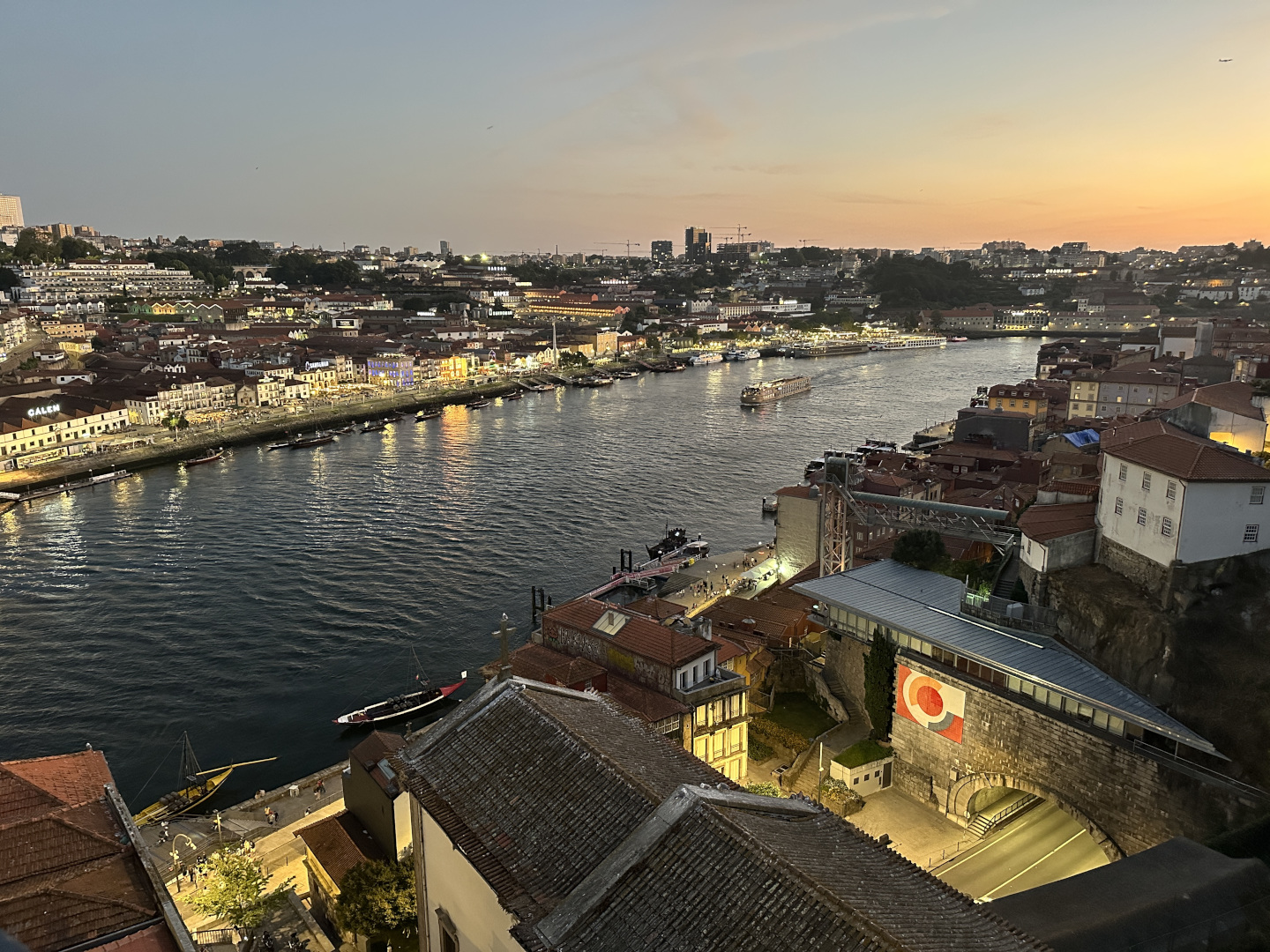
The upper deck, by contrast, is the tourist path. Shared with the metro, it offers sweeping panoramic views over the river and rooftops, and it’s also where you realize why Porto is called “the city of bridges.” From here, you can spot most of the six bridges that link Porto and Gaia, stretching westward along the Douro. It’s an iconic view of the region, especially at sunset, when the silhouettes of the bridges frame the golden river.
Spoiler alert: Porto won’t stop at six. By the end of 2025, a seventh bridge is expected to open, adding a new chapter to the city’s long relationship with the Douro.
To save yourself the climb back up from the lower deck, the Funicular dos Guindais is a practical option. The ride is short and more about convenience than sightseeing. But at only ~€4, on a hot day or after a few hours of walking, it’s a welcome alternative to the steep cobblestones.
Jardim do Morro
The Jardim do Morro wasn’t even on our radar until a Porto local suggested it, calling it the place to be on Thursday evenings. It turned out to be one of the most memorable, non-planned moments of our stay. Every Thursday, people gather here to watch the sunset over the Douro, while local bands play free concerts. The evening we went, a group was performing Red Hot Chili Peppers covers — unexpected, lively, and exactly the kind of authentic surprise that makes a trip special.
The park itself is built on a slope, so people naturally settle into the grass with blankets, or perch on the concrete benches embedded into the hillside. Vendors wander through the crowd selling beer, water, and other drinks, and remarkably, they even take contactless card payments. It’s casual, social, and very local: a mix of tourists who stumbled onto it and Porto residents who know this is where the week winds down.
Dining and Strolling Along the Douro in Gaia
Crossing to the Gaia side, the riverside promenade is one of Porto’s most relaxing walks. Even though cars are technically allowed, very few pass through — the area is dominated by pedestrians enjoying the views, the terraces, and the slower rhythm of the riverbank.
Right at the exit of the lower deck of the bridge, we stopped at Dom Pipas for what turned out to be one of the most refreshing breaks of our trip: a glass of fresh lemonade. And here, “lemonade” really means water with freshly pressed lemon juice, made in front of us, with no sugar added. Don’t expect the sweet, commercial drink we’re used to; this is sharp, citrusy, and pure. On a hot afternoon, it was exactly what we needed.
The promenade itself is lined with terraces of restaurants, almost wall-to-wall. Prices are, unsurprisingly, a little higher than elsewhere in Porto, and the atmosphere leans touristy. The food, however, is generally good. We tried two different places:
- Bacalhoeiro — A better choice. Here, the preparation and presentation of the dishes felt more careful, and the flavors came together with more finesse.
- Tempero d’Maria — Highly rated on TripAdvisor, but our experience was only average. The fish was served with far too many bones, which detracted from the enjoyment.
In short, dining along Gaia’s riverfront comes with a location premium, but the setting is hard to rival. As evening falls, the sunset over the Douro and the sight of Porto gradually lighting up on the opposite bank create a backdrop that elevates the entire experience. With the right table and a well-prepared dish, it’s one of those moments where you forgive the higher prices — because the view itself is unforgettable.


🌊 Westward to the Atlantic: Foz do Douro and the Ocean Breeze
If the heart of Porto is steep alleys and tiled churches, its west side is where the city exhales. The classic way to get there is aboard the historic tram nº1, which rattles along the Douro from the Ribeira to Foz. The tram is undeniably charming — a wooden carriage straight out of another era — but let’s be clear: this is about the ride, not the comfort.
The seats are hard wood, the carriage bumps and shakes, and the tram stops often. It’s slow, sometimes slower than walking, and the ticket costs more than a standard bus or modern tram. You pay directly to the conductor (yes, even with contactless card payment), and what you’re buying is nostalgia, not efficiency. If you expect comfort or speed, you’ll be disappointed. But if you accept it for what it is — a moving time capsule — the ride has its charm.
The tram line ends at the entrance of the Jardim do Passeio Alegre, a long riverside park shaded by mature trees. On a hot July or August afternoon, the shade here is a relief. From the park, it’s a short, pleasant walk out to the last arm of land before the Atlantic, where the Douro meets the ocean. A path leads to the Farolim da Barra do Douro lighthouse, passing by a small hidden beach, the Praia das Pastoras, where locals gather away from the crowds.
Beside it stands the Fort of São João da Foz. Sadly, this landmark is underwhelming: poorly maintained, with no signage or context, and sitting awkwardly beside a tennis club. It feels like a forgotten relic more than a historical site.
Locals also encouraged us to continue further north to Matosinhos, known for its wide beaches and outstanding seafood. Unfortunately, we ran out of time, but it’s high on our list for next time — and from what we’ve heard, it’s still relatively untouristed, at least for now.
In the end, the west of Porto isn’t about iconic monuments but about contrast. After days of cobblestone climbs and tight alleyways, reaching the ocean feels like breathing out. Watching the sun sink into the Atlantic closes the loop: Porto is not only about wine, azulejos, and bridges, but also about the raw beauty of the sea at its edge.


✨ Visit Porto City: Key Takeaways
Visiting Porto City is about embracing contrasts. The city charms with its tiled façades, historic churches, vibrant markets, and riverside views — but it also tests visitors with steep cobblestones, tourist traps, and crowded landmarks.
Some highlights stand out clearly: the climb up the Clérigos Tower despite its cramped stairs; the authenticity of the Mercado do Bolhão compared to the over-the-top Café Majestic; the surprise of a Thursday night concert at the Jardim do Morro; or a sunset walk along the Dom Luís I Bridge with Porto’s skyline glowing across the Douro.
At the same time, being critical makes the experience better. Not every tiled church is worth a detour, not every restaurant on Gaia’s riverfront lives up to its prices, and not every myth (hello, Livraria Lello) should be believed.
In the end, Porto rewards those who explore it with open eyes and realistic expectations. Wear good shoes, pick your visits with discernment, and don’t hesitate to step away from the guidebook “must-dos” to enjoy the city’s everyday rhythm — a late walk on Santa Catarina, a glass of vinho verde in a small tasca, or the laughter of locals at sunset.
And if Porto city gives you the taste, the story continues across the river and beyond: in Gaia’s port houses and the vineyards of the Douro Valley — a topic that truly deserves an article of its own.
Porto intra-muros is texture, not polish. And that texture is what makes the city unforgettable.
👉 You’ll find more stories like this in the Destinations – Portugal section.
Want to learn more?
Join my newsletter!